ADHD at School: What Helps, According to Research
In short.
- School support really does help children with ADHD: attention, learning, behaviour and getting on with other children improve — step by step.
- Hyperactivity and impulsivity are harder to change. Here it helps to give the child more chances to move, rather than asking them to sit still.
- In most of the studies, the support was given by teachers and other school staff — so a lot can be done in an ordinary classroom.
- You do not have to do everything at once. Start with one difficulty, one idea and 2–4 weeks of patience.
ADHD in a nutshell
ADHD (attention deficit hyperactivity disorder) is a condition linked to how the brain develops. A child with ADHD may find it hard to stay focused, get organised, follow instructions, wait their turn or stay seated.
It is worth saying clearly: this is not laziness, and it is not the parents’ fault. The child is not “refusing” — things are simply harder for them. ADHD does not mean a child cannot learn well. With the right support, they can take part more fully in class and show their strengths.
More about the signs: Attention Deficit and Hyperactivity.
What the research shows
In July 2025, researchers from the University of York (UK) reviewed 26 randomised controlled trials of school-based support for children and young people with ADHD aged 4 to 18. Twenty-two of these trials, with 1,962 participants, were included in the overall analysis [1].
“Randomised controlled” means that children are assigned by chance: some receive the support, others do not, and the two groups are then compared. It is one of the most reliable ways to test whether something helps.
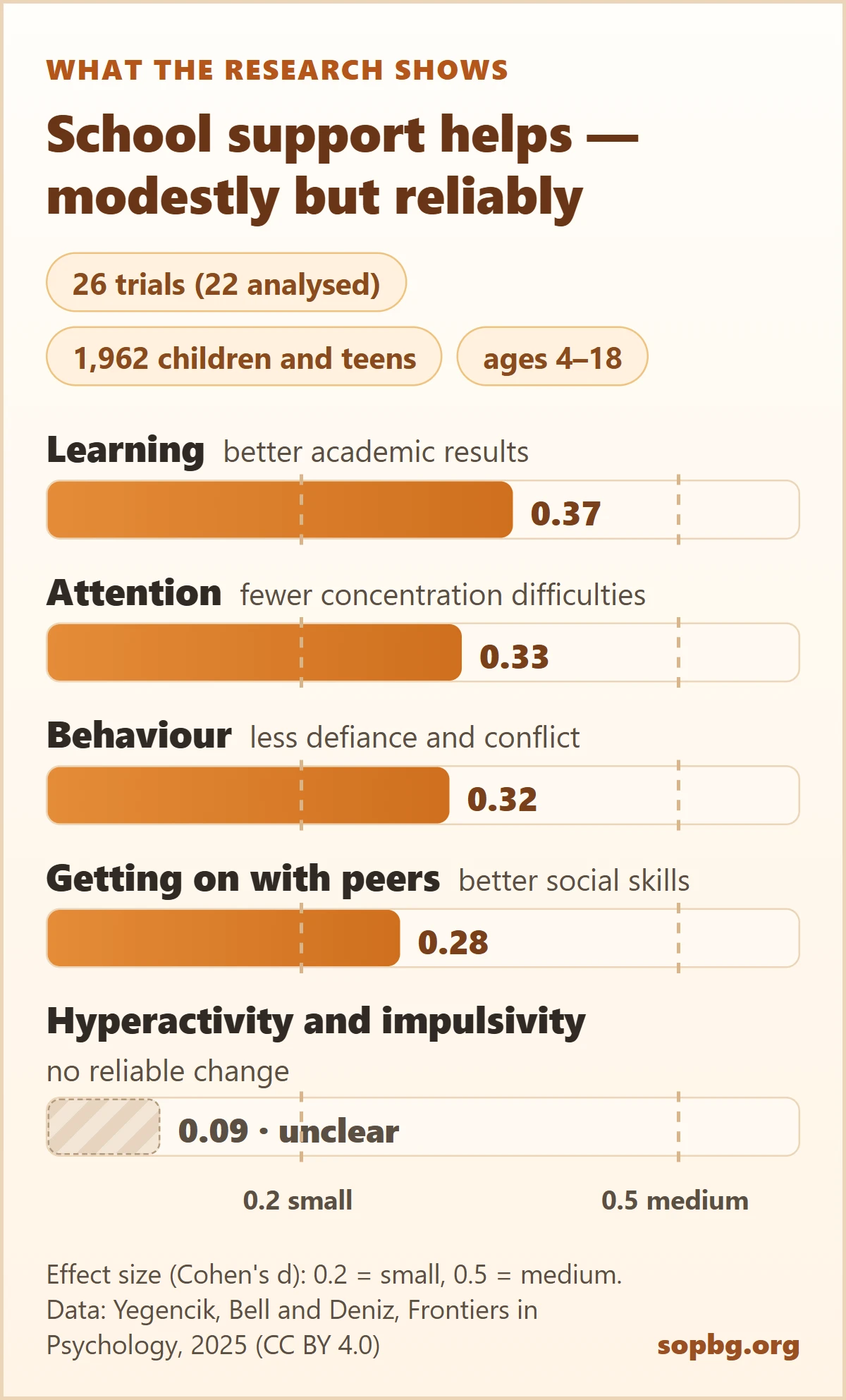
How much school support helps. Effect size (Cohen’s d) based on data from [1]: 0.2 = small, 0.5 = medium effect.
What this means
- It helps — step by step. The changes are small to moderate, but reliable (statistically significant). Every child responds in their own way, so patience and consistency are your allies.
- Attention and learning gain the most. For primary school pupils the effect on these is stronger — one more reason to start support early.
- Hyperactivity and impulsivity are harder to change. So it is not fair to expect the child to “just sit still”. It is much more useful to adapt the environment — for example, with short movement breaks.
- Teachers can do a lot. In 17 of the 24 studies that reported who delivered the support, it was teachers and other school staff.
5 practical strategies for the classroom
The strategies below combine the findings of the review [1] with guidance from the CDC (USA) [2] and NICE (UK) [3]. They are not one programme tested as a whole. You do not need to use them all — pick one or two that feel easiest to start with.
1. Short, clear instructions — one step at a time
When they hear several things at once, a child with ADHD easily loses track — not because they are not listening, but because it is hard to keep everything in mind. Break the task into small steps and give the next one when the previous one is done.
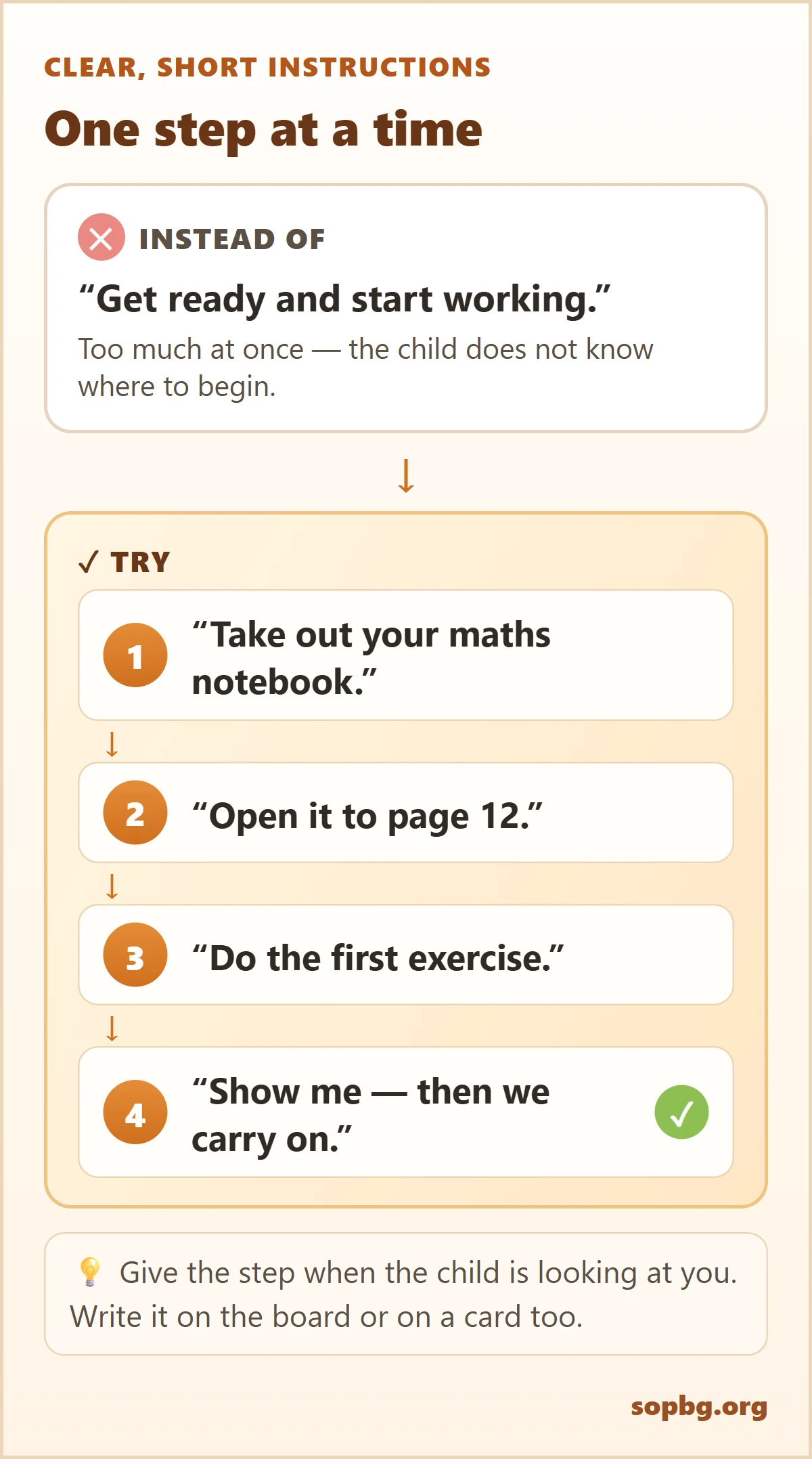
More examples:
- Instead of “Pay attention!” → “Look at me. Listen to the first task.”
- Instead of “Tidy your desk.” → “Leave only your book and pencil on the desk.”
- Instead of “Write faster.” → “Write the first two lines. Then we will check together.”
- Instead of “Don’t forget your homework.” → “Write your homework in your planner and show me before the bell.”
How to say it:
- Give the instruction when the child is looking at you. You can say their name first — calmly and with a smile.
- Back up spoken instructions with written ones — on the board, on a note or on a card on the desk [3].
- Ask the child to repeat in their own words what they are going to do.
2. A predictable day
When a child knows what comes next, they feel safer, get organised more easily and move from one activity to another more smoothly.
- A daily schedule in plain sight — in words or pictures.
- A warning before a change: “In 5 minutes we will finish and start reading.” [2]
- A short task list — children enjoy ticking off each finished task.
- One homework folder and the same place for the things in the school bag [2].
3. Specific praise — straight away
Children with ADHD often hear more criticism than praise. Every specific word of praise shows them that you see them and that their effort matters. Notice the good moments and say so out loud — straight away and specifically. The formula is simple: what I saw + why it matters.
- Instead of “Well done!” → “You started the task on your own. That is an important step.”
- Instead of “Very good.” → “You waited for your turn while Maria was speaking. Thank you.”
- Instead of “Finally!” → “You finished the whole page. I can see you worked hard.”
Small, quick rewards also help: a point on the daily card, choosing an activity, a helper role in class. Rewards and daily report cards are part of well-researched approaches to classroom behaviour [2].
4. An environment that helps
NICE guidance [3] recommends adapting the environment to the child. For example:
- ✅ a seat with fewer distractions — for example, away from the door and the window;
- ✅ less noise — some children use headphones during independent work;
- ✅ shorter periods of work with movement breaks — for example, handing out worksheets or wiping the board;
- ✅ an “I need a break” card the child can show instead of suddenly getting up;
- ✅ long tasks broken into shorter parts [2];
- ✅ a teaching assistant, where there is one.
Not every change suits every child — and that is perfectly normal. Try one at a time and see what helps your child.
5. Parents and teachers — one team
A child gains the most when the adults around them work together. Agree on 1–2 specific goals and keep in touch briefly every day. The CDC highlights the daily report card, with daily contact with parents, as useful [2]. Here is an example:
| Today’s goal | Lessons 1–2 | Lessons 3–4 | Lessons 5–6 |
|---|---|---|---|
| I start the task on my own | ☐ | ☐ | ☐ |
| I put my hand up before speaking | ☐ | ☐ | ☐ |
| I wrote down my homework | — | — | ☐ |
Teacher’s note: ……………… Parent’s signature: ………………
- The teacher ticks ✓ at the end of the lessons — it takes seconds.
- The child takes the card home every day.
- The parent celebrates every ✓ together with the child. Empty boxes are not a reason for punishment — tomorrow is a new day.
- Together you agree on a small reward at home when the child collects the agreed number of ✓ — for example, choosing an evening game.
- Start with goals the child reaches on most days, and raise them gradually. That way the child feels success more often.
For parents: small things that help at home
You know your child best. Here are a few ideas that make the day calmer — for your child and for you.
- A morning checklist with pictures: get up → get dressed → breakfast → teeth → school bag → shoes.
- Pack the school bag the evening before, with a short list and together with the child.
- Homework in the same place and at the same time, with no TV nearby, in short parts with breaks.
- One instruction at a time at home too: “Put your shoes on.”, not “Get dressed, we’re late!”
- Sleep and movement — enough sleep and plenty of movement during the day help every child.
- Talk to the teacher early — share what helps at home and ask what works in class. You are on the same team.
- Look after yourself too. Rest and support from the people close to you give you strength for everyday life.
If you are offered a parenting programme, it is not a criticism. NICE guidance says exactly this: it does not mean you have failed as a parent. The aim is to give you more tools, because children with ADHD need more support than usual [3].
For teachers: a quick checklist
- ☐ The child sits in a place with fewer distractions.
- ☐ Instructions are short — one step — and written down.
- ☐ The daily schedule is in plain sight.
- ☐ I give a warning a few minutes before a change of activity.
- ☐ I name a few good moments out loud every day.
- ☐ There are movement breaks.
- ☐ Long tasks are broken into parts.
- ☐ I send parents brief feedback every day.
How to get started: a 2–4 week plan
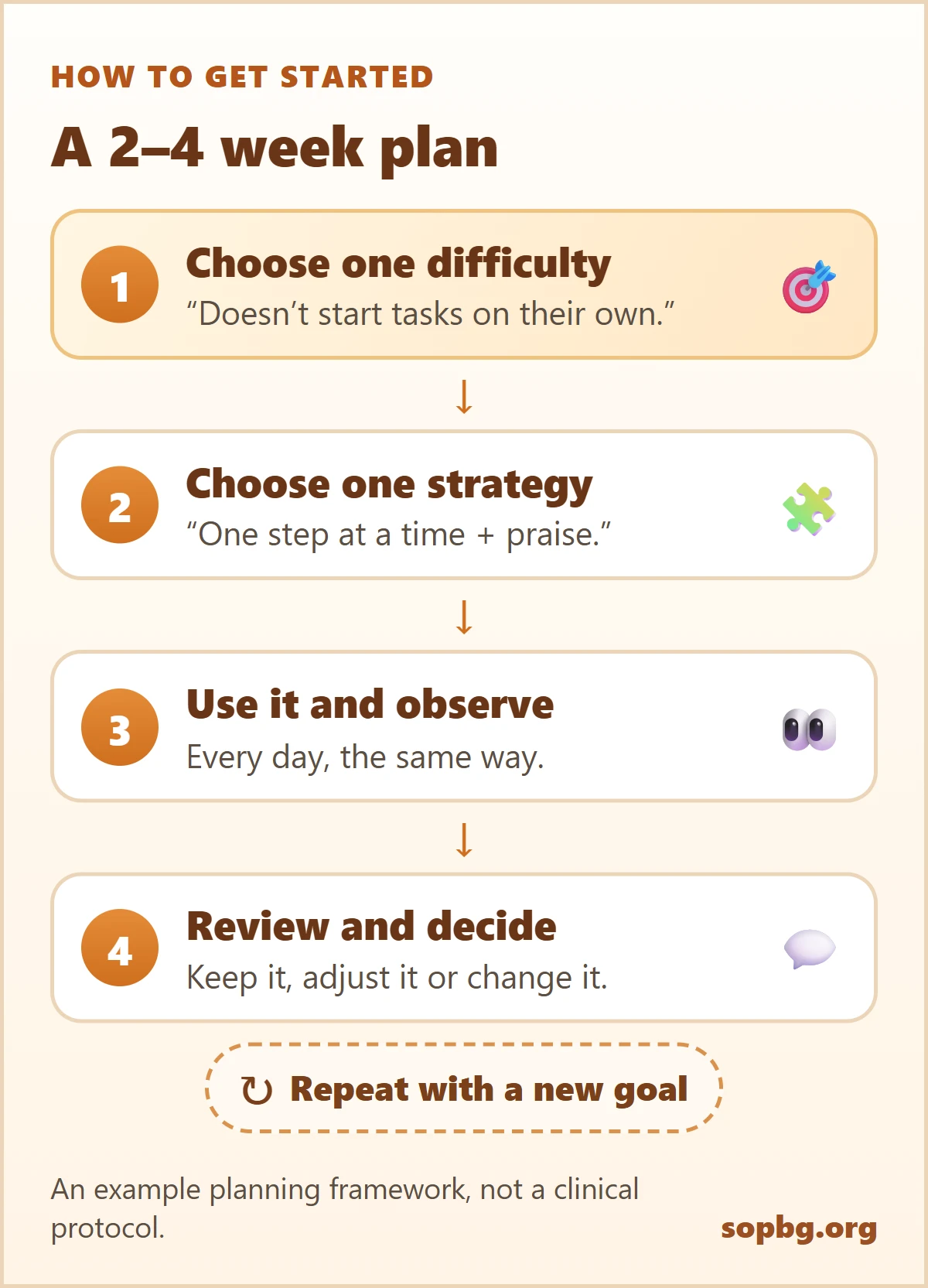
- Choose one difficulty that gets in the way of learning most — for example, “doesn’t start tasks on their own”. Note when and how often it happens.
- Choose one strategy from those above and agree who does what — in class and at home.
- Use it every day in the same way and record it on the daily card.
- After 2–4 weeks, review: is starting tasks easier? Is the child calmer? Keep, adjust or change the strategy.
Celebrate the small wins too — they show you are on the right track. This is an example planning framework, not a clinically tested protocol. If the child has a support plan at school, the goals can be linked to it.
When to seek professional advice
Seeking professional advice does not mean you have missed something. Sometimes it is simply the best next step. Consider it when:
- the difficulties last for months and affect learning, friendships or family life;
- school support has not helped after several attempts;
- the child is often sad or anxious, or calls themselves “bad” or “stupid”.
ADHD is diagnosed by a qualified specialist (for example, a child psychiatrist) after a full assessment, not from a questionnaire alone [3]. The strategies in this article do not prevent ADHD, but early support may reduce some of the difficulties with learning, organisation and relationships. If you have a question, see Contact a specialist.
What are the limitations?
- The studies used different approaches, durations and ways of measuring, and their results vary.
- Of the 26 studies, 6 had a high risk of bias and 12 had some concerns. In most, the assessors knew which children received the support.
- For overall symptoms and for attention, there are signs that studies with positive results were more likely to be published. So the real effect may be a little smaller.
- The review did not examine whether the improvements last long after the support ends.
- School support is important, but it does not replace individual assessment and treatment when they are needed.
Finally
The aim is not for the child to be like everyone else, but to have a real chance to learn, take part and build on their strengths. Every small, consistent step — in class and at home — matters. And you are not alone in this.
References
- Yegencik, B., Bell, B. T., & Deniz, E. (2025). School-based randomized controlled trials for ADHD and accompanying impairments: a systematic review and meta-analysis. Frontiers in Psychology, 16, 1611145. https://doi.org/10.3389/fpsyg.2025.1611145
- Centers for Disease Control and Prevention (CDC). ADHD in the Classroom. https://www.cdc.gov/adhd/treatment/classroom.html
- National Institute for Health and Care Excellence (NICE). Attention deficit hyperactivity disorder: diagnosis and management (NG87). https://www.nice.org.uk/guidance/ng87/chapter/Recommendations